Architecture
As of v0.4.0 (PR #159) Topos
is an all-Rust Cargo workspace.
There is no Python implementation anywhere in the stack — the topos-mcp
PyPI package is a thin wheel bundling a compiled binary, not a Python
package. For the underlying math, see Concepts; for what each metric
means, see Measures.
The three crates
Crate |
Role |
|---|---|
|
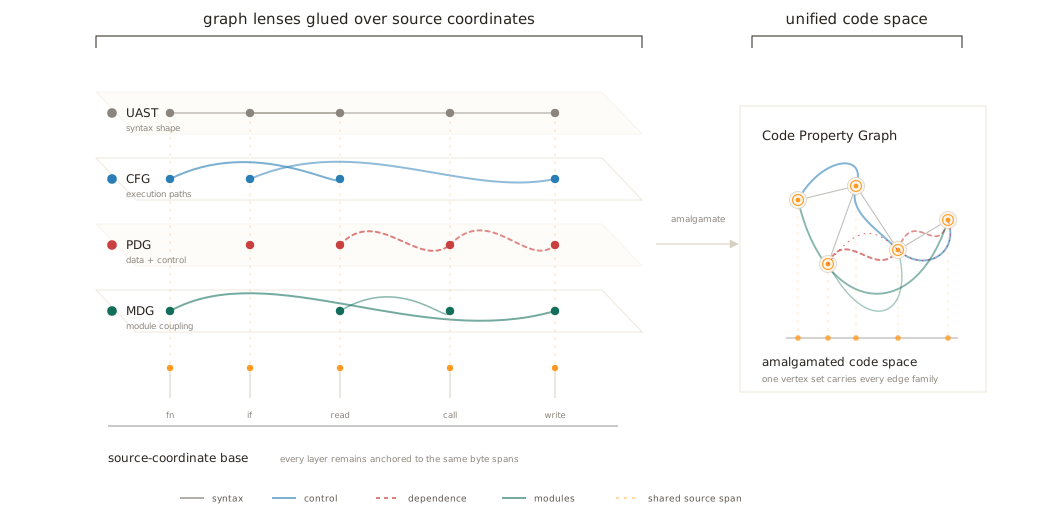
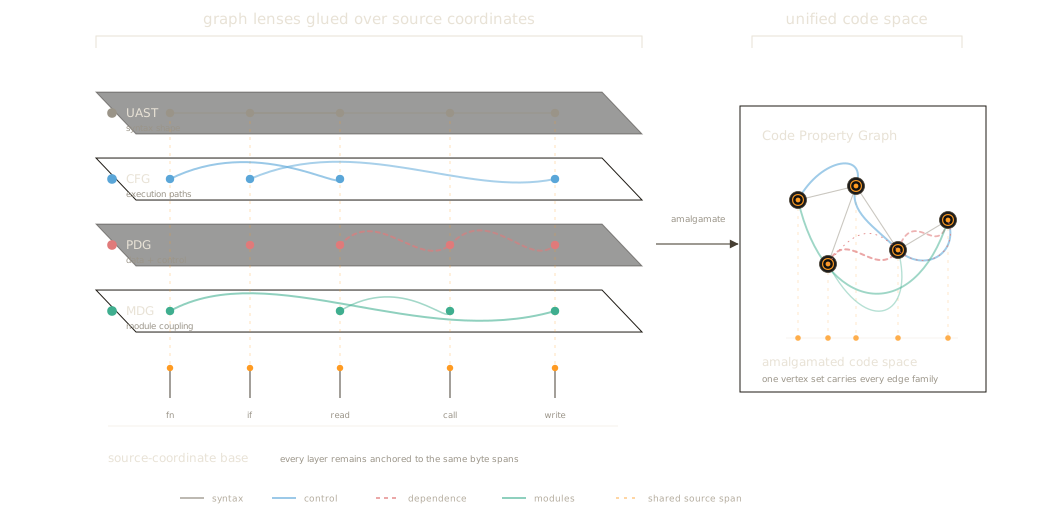
The pure compute engine: tree-sitter AST parsing, the CFG / MDG / CPG
/ PDG / UAST graph representations, the characteristic morphism
\(\chi_S : \text{Program} \to \Omega\), the SIMPLE/COMPOSABLE/
SECURE scoring policies, and all refactor-suite probes (cycle basis,
Forman/Forman-Ricci curvature). External
tools (GitNexus) are reached only through |
|
The CLI binary: |
|
The MCP server (the |
External tools stay at the edges
Two external tools feed Topos, and both are reached the same way — a
subprocess adapter in topos-engine::adapters, never a library dependency
pulled into the scoring path:
- GitNexus
Builds the cross-file module dependency graph that the COMPOSABLE pillar scores. This is the one external tool whose output actually feeds the evaluation lattice.
Sighthound is different: it’s
compiled directly into topos-mcp as a Rust library
dependency (no subprocess, no $PATH discovery), and it only supplies
supplementary security_findings detail — the SECURE score itself always
comes from topos-engine’s native CPG probes, never from Sighthound.
The advisory refactor suite
Beyond the scored medal, topos_refactor (MCP) surfaces ranked
structural hotspots from three independent engines. None of these feed
the four scored pillars —
see For Agents for the tool contract and docs/decisions/refactor-suite.md in the
repository for the full design rationale:
cycles— CFG cycle-basis extraction (persistent-homology-flavored), pointing at the actual loop/branch bodies behind cyclomatic complexity.dependencies— balanced Forman curvature over the MDG, naming load-bearing import edges.process— directed Forman-Ricci curvature over GitNexus process graphs, flagging execution-path choke points.
Rust API docs
This Sphinx site doesn’t autodoc the Rust crates (there’s no Python module to introspect anymore). For the compiled API surface, generate rustdoc locally:
git clone https://github.com/Krv-Labs/topos.git
cd topos
cargo doc --workspace --no-deps --open
topos-engine and topos are not yet published to crates.io (tracked
in issue #149); until then,
rustdoc generated locally or the source on GitHub are the primary references.